 Consilient Lens
Digital Reflections: The Courtesy Code

If a machine responds better to courtesy, maybe it’s just proving that good manners are finally contagious — even to our own inventions.
In the early days, when models were still clunky but my expectations were sky-high, I would get frustrated:
“But I just said this — why aren’t you remembering it?”
My then elementary-school daughter cut in:
“Daddy, you’re forgetting your please and thank you’s.”
Add a “please” or “thank you” to your prompt and suddenly the machine seems more thoughtful. Why does tone matter to a machine that doesn’t feel?
Her reminder stopped me. It felt absurd — but also familiar.
How many times have I seen the same thing in human conversations? The rushed email with no greeting that triggers defensiveness. The brief “thanks” at the end of a meeting that suddenly makes the whole exchange feel smoother.
Rude vs. Courteous Prompts
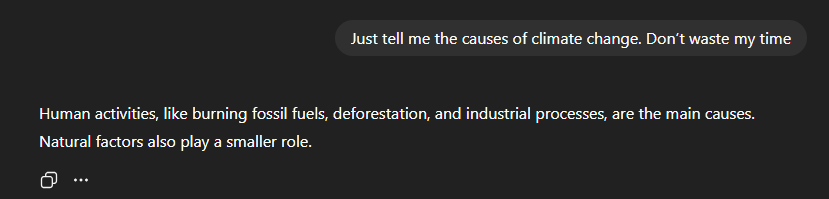
rude prompt
 courteous prompt
Research backs this up: a 2024 study, “Should We Respect LLMs? A Cross-Lingual Study on the Influence of Prompt Politeness on LLM Performance?” (Yin et al.), found that polite prompts often lead to more thoughtful, detailed responses.
Models are evolving. Some of the newer ones are getting better at ignoring rude prompts.
Large language models (LLMs) are trained on oceans of human language. When you lace your prompt with courtesy, the model draws from patterns where respect is followed by nuance and elaboration.
The AI isn’t grateful. It’s predictive.
Still – politeness produces better answers. Strange, right?
If a machine, without ego, performs better when treated courteously, what does that say about us — the creatures who wrote the data it trained on? We like to think we’re rational. But like the model, we’re swayed by signals we barely notice.
Politeness is a social shorthand — a small phrase that carries a big meaning: “I respect you. I see you. I value your answer.”
But can you be too polite? Yes. Sometimes it hides the truth. When courtesy turns into avoidance, problems often stay buried.
The lesson isn’t “always be polite.” It’s: politeness is a lever — and like all levers, it can be misused.
Overly-Polite Prompt
 —
—
Politeness is like salt: just enough enriches the meal; too much suppresses the flavor.
?? Has politeness ever helped you unlock a better outcome — or held you back from saying what needed to be said?
But politeness without context? That’s an empty ritual.
The next reflection is about context — the frame that makes meaning possible.
Originally written in October 2025. Migrated to consilientlens.com in April 2026.