 Consilient Lens
Digital Reflections: Hallucinations

Ask an AI about an obscure historical figure and it might give you a full story — confident, smooth, dates and books and philosophies. All fake.
In the early days, my daughter and I used ChatGPT to quiz each other. Sometimes it just made things up. Years, names, places. We believed it.
Later, a quick Google — nothing there.
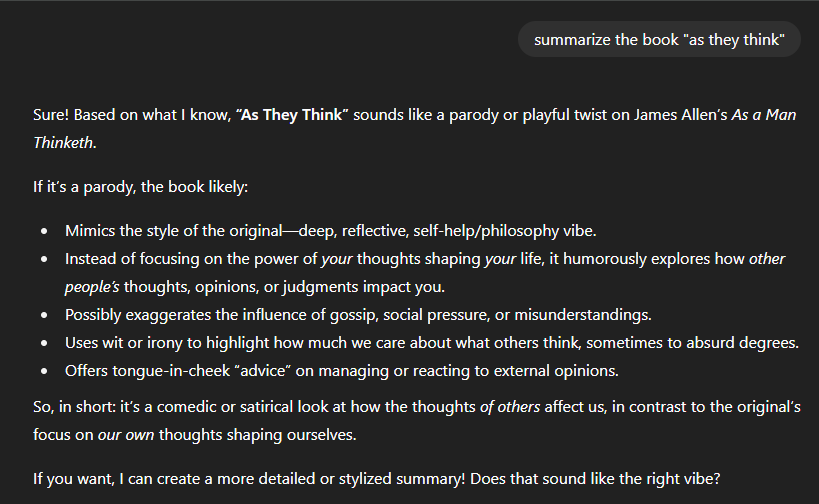
That’s what people call hallucination. LLMs aren’t truth-seekers — they’re probability poets, stacking the most likely syllable on the next. So the mistake comes wrapped in fluency. A masterful lie.
But isn’t that us too? Our brains are probability machines. We guess what someone will say. We bluff.
Evolution made confidence a survival trick — look bigger, sound certain, get through the moment. Even now, we follow leaders who sound right, not always those who are right.
Psychologists put labels on it: confabulation, Dunning–Kruger, impression management.
An article titled “Could the ‘Hallucination’ of Generative AI Large Language Models (LLM) be emerging evidence of a dangerous new trend toward the ‘AGI Dunning-Kruger Effect’?” touches on similar territory.
I just call it filling gaps to keep the story — and our pride — intact.
So when AI invents facts, we laugh. But don’t we do the same — in meetings, in arguments, in stories we retell?
We want to be right. Or at least sound right. And the world often rewards confidence over truth.
Though we claim to value truth above all, we reward fluency, certainty, speed. But in practice? Speed, certainty, fluency win the day.
No one likes the pause. No one likes “I don’t know.”
The hard part isn’t fixing hallucinations in code. It’s facing them in ourselves.
The lesson is humility — to build systems, and habits, that leave room for error. To prefer a quiet “I don’t know” over a beautiful lie.
Have you ever been confidently wrong? Did it make you more skeptical of others — or more forgiving?
But before we judge the machine too harshly, maybe we should notice how it listens before it speaks.
That pause is the next mirror: patience and listening.
Originally written in October 2025. Migrated to consilientlens.com in April 2026.