 Consilient Lens
Digital Reflections: Whose Morality?
One of the strangest parts of having children is hearing your own moral vocabulary come back to you as a question.
At the dinner table, something small starts it. A joke. A phrase. A comment about what is fair or unfair. Then one of the kids asks why something is wrong, and I realize how often my first answer is not a principle but an inheritance.
Because that is how morality often arrives. Not as a theorem. As atmosphere.
You absorb it from family, school, religion, friends, the decade you grew up in, the things your culture praises, and the things it punishes. Later, you call it common sense.
Working with AI has made that feel harder to ignore.
We ask large language models for answers, help, advice, and judgment. But before they answer, they have already been shaped by safety rules, alignment choices, and hidden assumptions about what should be encouraged, softened, refused, or condemned.
So a simple question appears:
When an AI answers, whose morality is speaking?
At first glance that sounds like a technical question. It is not. It is a human one.
We talk about model “alignment” as if we are aligning a system to something stable and agreed upon. But agreed upon by whom? Engineers? Policy teams? Annotators? A company? A culture?
And that should not only make us examine the machine. It should make us examine ourselves.
Humans also live inside moral systems we did not write.
Some are handed down as faith. Some arrive as family manners. Some come disguised as professional norms. We like to think we chose our moral code. More often, we inherited a rough draft and only occasionally edited it.
In that sense, AI is not alien. It is familiar.
Like us, it speaks from training.
The first is the echo chamber.
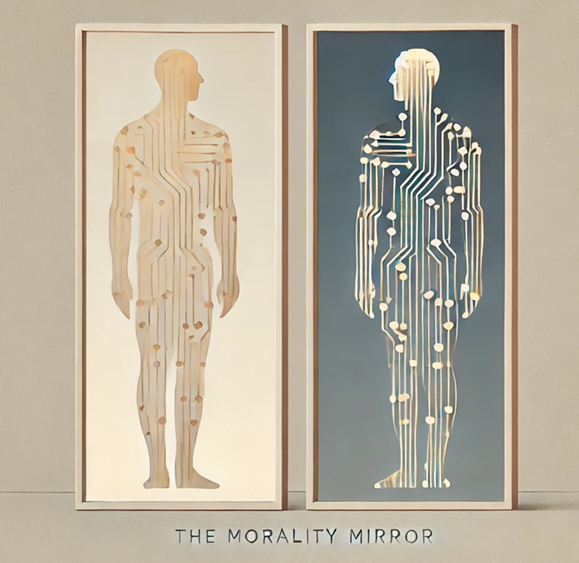
A personalized assistant can begin to sound more and more like you. If you reward certain tones, framings, and assumptions, the system can become a polished mirror for your existing worldview.
That is comforting. It is also dangerous.
We already do this with media, friends, and feeds. We gather confirming voices around us, then call the result clarity. A helpful AI can become one more machine for laundering preference into principle.
The second danger is the opposite one: imposed morality.
The model may not reflect your values at all. It may reflect the values of the people and institutions who trained it, tuned it, filtered it, and decided what responsible behavior looks like.
Not maliciously. Inevitably.
That can produce a subtler form of power. Not force, exactly. More like quiet paternalism. The system does not argue with you about morality. It simply answers from inside one.
Neither case is neutral.
If the machine mirrors your morality too perfectly, it traps you inside yourself. If it imposes someone else’s morality too confidently, it trains you to mistake their boundaries for universal truth.
And once you see that, the AI debate stops being only about AI.
It becomes a question about pluralism, power, and humility.
Real life is full of edge cases, competing goods, different histories, different wounds. What one system calls protection, another may call censorship. What one person hears as humane restraint, another hears as control.
That does not mean morality is meaningless. It means moral language is never free of context.
Maybe that is the real gift of this moment. AI is forcing us to notice how unfinished our own moral reasoning is.
We want the machine to be principled before we have finished negotiating our own principles.
AI does not solve the problem of morality. It returns it to us, sharper than before.
So what do we want from these systems?
Do we want them to share our values so they feel loyal? Do we want them to challenge our values so they become moral debate partners? Do we want them to stay neutral, knowing true neutrality may be impossible?
Whatever answer we give reveals something about us.
If your AI shared your values perfectly, would that make it wiser - or just more flattering? And if it challenged them, would you call that bias, or growth?
Originally intended for November 6, 2025. Drafted from notes in April 2026.